Shower Pressure Repair covers showerhead and fixture flow issues; typical repairs run $150–$500, depending on parts and access.
What to Check When Water Pressure Suddenly Falls Throughout Your House
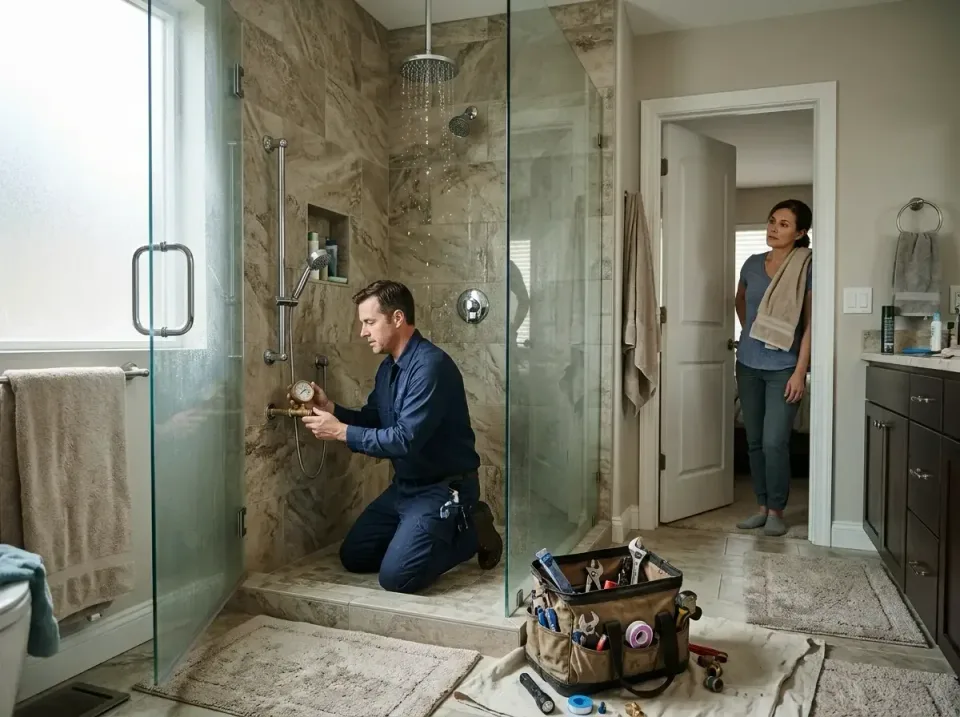
What Should You Check When Housewide Pressure Falls?
If water pressure suddenly falls throughout your house, first check whether every fixture is affected and whether the main shutoff is fully open. Avoid forcing a stuck valve; a plumber can compare readings at an accessible connection and trace the cause before recommending repairs. Kentucky homes see rain in every season, so take note of recent weather and any signs of water around the meter or in the basement.
Near the Florence Y’all Water Tower, its height is a familiar reminder that elevation and supply conditions can matter, but it does not diagnose your home’s plumbing. Cumberland Falls State Resort Park draws visitors to Kentucky’s water; at home, a sudden change deserves a measured check. We use those observations to narrow the next step.
What Can You Check First After a Sudden Pressure Drop?
If every tap weakened at once, ask whether the change affects hot and cold water, then check that the main shutoff handle has not been partly closed. Look for a recent repair, filter change, or valve adjustment that may have disturbed the supply.
Do not crank a stiff valve; an older valve can break or fail to reopen. Note whether toilets refill slowly and whether a laundry faucet also runs weakly.
That pattern helps distinguish a housewide supply problem from one blocked fixture. Our crew serving Kentucky starts with these observations, then tests accessible points instead of replacing parts based on a guess.
Does the Pressure Drop Appear at Every Fixture?
Compare two or three taps on different floors, including one cold-only and one hot-only fixture. If only one faucet struggles, debris at its aerator is a more likely local restriction than a problem affecting the entire home.
If both hot and cold are weak across the house, the cause may lie closer to the main supply, a shutoff, or a regulator. At a home near Blue Grass Airport, for example, we would still test the plumbing rather than assume the airport or neighborhood determines household pressure.
A housewide reading and a fixture-by-fixture pattern provide useful evidence. For other room-specific clues, see our guide to upstairs faucets that barely run.
When Is a Pressure Test More Useful Than Guessing?
A faucet’s stream can look weak even when the pressure reading seems normal, because pressure and flow are related but not identical. A technician can compare readings with water stopped and with a fixture running to see whether pressure falls under demand.
Pipe size also matters: metric and U.S. pipe dimensions use different measurement systems, so do not assume a pipe’s measured outside diameter is its nominal size. That distinction can affect which replacement fitting is appropriate.
Our crew has seen homeowners misidentify pipe size and buy a part that will not fit. At Churchill Downs, visitors watch small details shape the outcome; in plumbing, a correct measurement can prevent an unnecessary repair.
When Should You Stop DIY Checks and Call a Plumber?
You can safely observe fixtures, check whether the shutoff looks partly closed, and note whether a filter was recently serviced. Stop there if the valve leaks, the pressure loss persists across the home, or you hear water running when every fixture is off.
Ice storms can disrupt travel and plumbing service access, so record symptoms and any visible changes while arranging an inspection rather than attempting a risky repair in poor conditions. If pressure changes only when another tap runs, our article on shower pressure dropping when another tap is used explains that pattern.
Kentucky Plumbing Pros traces the loss, explains what testing shows, and completes only the agreed work with care.
Which Checks Help Find a Whole-House Pressure Drop?
The right check depends on whether the problem affects one fixture, the whole home, or a private-well system. Near Louisville Waterfront Park, changing river levels are not a substitute for checking a home’s actual plumbing; use the symptoms and measurements. Kentucky’s humid continental climate, with warm summers and cool winters, also means seasonal conditions can affect access to exposed equipment.
| Option | Best for | Key detail |
|---|---|---|
| Compare fixtures | One tap versus whole house | A single weak faucet may point to an aerator; multiple weak taps suggest a shared supply issue. |
| Check shutoff | Recent valve adjustment | Confirm the main valve is fully open without forcing it. |
| Measure pressure | Persistent housewide loss | Readings in PSI help separate supply pressure from a restriction under demand. |
| Inspect well equipment | Private-well homes | A pump or tank problem can affect multiple fixtures at once. |
Spring storms can bring heavy rain and localized flooding, so keep clear access to basement equipment and note any water intrusion. Start with the simplest safe observation.
A Pressure Reading Needs the Right Context
Pro tip: Don’t judge a home’s supply from a single faucet stream. Static pressure is measured while water is not running; a second reading under demand can show whether pressure collapses as flow begins, which helps separate a supply issue from a fixture restriction.
Near Bernheim Forest, seasonal temperature swings are a practical reason to inspect exposed plumbing and protect vulnerable sections before conditions change. A home near the Kentucky State Capitol may have different pipe materials and access than a newer house, so our crew checks the actual installation before choosing a repair.
The University of Louisville is another familiar local reference, not a substitute for inspecting the home’s system.
Common mistake: Turning a pressure control without measuring first can make the problem worse.
Common Questions About Low Water Pressure Repair in Kentucky
What If Water Pressure Suddenly Falls Throughout the House but Returns Later?
An intermittent loss can point to a changing supply condition, a valve issue, or equipment that struggles under demand, so record when it happens and which fixtures are affected. Cold snaps can freeze exterior hose bibs and service lines; check exposed areas for visible damage without applying heat or forcing a valve.
How Much Does Diagnosis Cost When Water Pressure Suddenly Falls Throughout the House?
Pressure diagnosis is typically $75–$250, with testing and access affecting the quote. Kentucky Plumbing Pros can explain the testing steps and access needed before work begins; if a repair is identified, its parts and scope are quoted separately.
Should I Try to Fix a Sudden Whole-House Pressure Drop Myself?
You can compare several fixtures and confirm that the main shutoff appears open, but call a plumber if the valve leaks, the loss persists, or you suspect a hidden leak. Freeze-thaw cycles can stress exposed plumbing and foundations, so avoid disturbing damaged piping while you arrange an inspection.
Do Kentucky Permits Matter for Repairs After a Sudden Pressure Loss?
They can: Kentucky State Plumbing Code, 815 KAR Chapter 20, and Kentucky plumbing permit and inspection requirements may apply depending on the work and location. A Kentucky licensed plumbing contractor can explain the applicable requirements before making a repair; Louisville Metro requirements may also apply within the metro area.
What Repair Might Come Next If Pressure Is Low Throughout My House?
If testing points to a damaged or restricted supply pipe, Water Line Leak Repair may be the next step; a pressure reading alone does not prove a leak. High humidity can encourage basement moisture and mold, so mention damp areas or unexplained water to the plumber and ask for the source to be traced.
When Should You Get Help with a Sudden Pressure Drop?
If pressure stays weak at several fixtures, changes sharply while water is running, or disappears after a valve adjustment, stop guessing and arrange a diagnosis. A home near Abraham Lincoln Birthplace National Historical Park still needs its own plumbing checked; a landmark cannot indicate whether a service line or valve is failing.
Hot, humid summers increase indoor cooling demand, so a lingering water problem can add frustration during busy household routines. In Covington’s MainStrasse Village, older buildings make it especially important to identify the actual pipe and valve before repair.
Keep it simple. Note which taps are affected and whether hot or cold water changed first. Contact Kentucky Plumbing Pros to discuss the symptoms and schedule water pressure diagnosis; we’ll explain the findings and agreed repair clearly.
Services Offered
Services We Offer in Louisville, KY
Explore related services available in Louisville, KY.
We test home pressure at hose bibs or laundry connections; access and seasonal protection needs shape the quote. University of Kentucky homeowners can plan around year-round rain and autumn pipe checks.
Whole-house pressure repairs trace weak flow across residential plumbing; typical work may run $150–$1,500, depending on access and repair scope.
No Water Pressure Repair tracks a complete home water loss to a valve, service line, or supply problem; many straightforward visits run about $100–$500, depending on access and repair scope.
We trace sudden home-wide pressure drops and repair the cause; access, parts, and the affected line determine typical job cost.
We trace weak hot-water flow to restrictions in the heater or hot-water piping; repair scope and access shape the quote. Churchill Downs-area homes can schedule around storm-season disruption.
We trace changing household pressure to its cause and repair the affected components; many straightforward jobs run $150–$500, depending on parts and access.
We repair or replace residential pressure regulators, checking valve condition and connections; parts, access, and regulator size shape the job cost.
We repair residential filter housings and cartridges; Newport Aquarium visitors know clean water matters, while storms near Churchill Downs can complicate access.
We locate and repair leaking water service lines, including buried pipe sections; typical repairs run $250–$1,500, depending on leak location and excavation.
Single Faucet Pressure Repair clears faucet aerator blockages and addresses fixture-level flow problems for homeowners; typical repairs run $125–$350, depending on access and parts.
We repair or replace residential main shutoff valves, accounting for valve size and access; replacement commonly runs $200–$600.
We repair residential well pumps, checking pressure controls and accessible connections; typical costs depend on pump components and site access.
We repair residential well pressure tanks, including tank components; typical jobs run $250–$1,200, depending on tank capacity and parts needed.
Clogged water line repair clears buildup in accessible home pipes; typical jobs run $150–$600, depending on blockage location and access.
Pipe Scale Removal clears mineral buildup from accessible household piping; typical jobs run $300–$1,500, depending on pipe length, access, and scale severity.
Cities & Towns
Service Areas in Louisville
Select a city to find local low water pressure repair providers we cover in Louisville.
Independence, KY41051Fort Wright, KY41011Mount Sterling, KY40353Ludlow, KY41016Barbourville, KY40906Campbellsville, KY42718Windy Hills, KY40207Murray, KY42071Middletown, KY40243Bardstown, KY40004Paintsville, KY41240Crestwood, KY40014Park Hills, KY41011Prestonsburg, KY41653Fort Knox, KY40121Lebanon Junction, KY40150Thruston, KY42303Francisville, KY41048Winchester, KY40391Burlington, KY41005Florence, KY41042Providence, KY42450Flatwoods, KY41139Crescent Springs, KY41017
Show all 171 cities
Morganfield, KY42437Mayfield, KY42066Williamstown, KY41097Berea, KY40404Madisonville, KY42431Whitesburg, KY41858Eminence, KY40019Ashland, KY41101Brooks, KY40109Cave City, KY42127La Grange, KY40031Anchorage, KY40223Bellevue, KY41073Versailles, KY40383Springfield, KY40069Albany, KY42602Jeffersontown, KY40220Georgetown, KY40324Pikeville, KY41501Nicholasville, KY40356Walton, KY41094Mount Vernon, KY40456Brandenburg, KY40108Buckner, KY40010Falmouth, KY41040Raceland, KY41169
Get a Quote
Get a Low Water Pressure Repair Quote in Louisville, KY
Share job details below or call our team directly. Phone: (877) 773-0781